Age verification
Are you 18 years of age or older?
How BLS prepares for winter
From heated points and all-season tyres suitable for winter conditions to a rotary snow blower: discover how BLS prepares for the cold season and works to keep services running as reliably as possible, even in winter.
When the first snow falls, the busy winter season begins at BLS. Months in advance, specialists prepare vehicles, stations and railway infrastructure for ice, snow and low temperatures. On days with heavy snowfall, up to 100 employees are deployed to keep trains and buses running as reliably as possible.
Our trains
The temperature on BLS trains is controlled automatically. In winter, it is around 21 degrees Celsius on S-Bahn trains and slightly higher on InterRegio and RegioExpress services. To ensure that the heating works reliably even in cold temperatures, our workshop employees check the temperature sensors during the autumn inspection.
All trains are equipped with obstacle deflectors. These robust components at the front of the trains can push aside small obstacles and snow up to approximately ten centimetres deep.
For good visibility, the windscreens are heated and fitted with windscreen wipers. To protect parked trains against the cold, they also have a standby mode that maintains a minimum level of heating.
Our buses
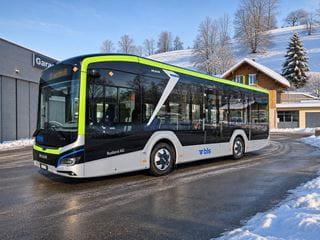
BLS buses operate with all-season tyres suitable for winter conditions. Before the winter season begins, their condition is checked in the workshop and they are replaced in good time if necessary.
The temperature inside the vehicle is regulated automatically. In older vehicles, drivers can adjust the temperature, while newer vehicles regulate it automatically based on the outside temperature.
Our bus drivers receive regular training to deal with winter hazards and difficult road conditions.
Our stations
BLS clears snow from platforms, ramps, stairs, underpasses and overpasses so that passengers can use public transport safely even in winter.
Busy stations such as Thun and Spiez are given priority. Winter maintenance staff often start work there as early as 4 a.m. These stations are cleared of snow at least twice a day. All 115 stations and stops on the BLS network are cleared of snow at least once a day.
Point heating systems
Snow and ice can block railway points. That is why the more than 800 sets of points on our rail network are automatically heated during the cold season. This keeps them operational even in winter conditions.
To ensure reliable operation, our specialists inspect all point heating systems in autumn. An on-call service is available around the clock to deal with disruptions caused by snow, ice or technical faults.
Heavy-duty snow-clearing equipment in the Bernese Oberland
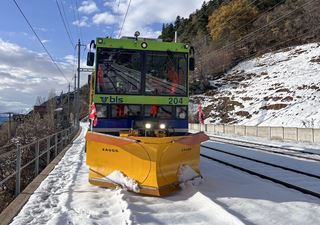
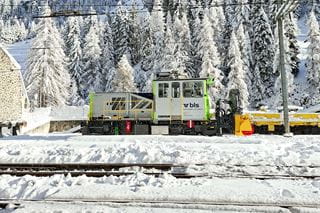
Special snow-clearing vehicles are ready for deployment in the Kander Valley, Simmental, on the southern Lötschberg ramp and in the Swiss Plateau. Track maintenance vehicles fitted with front-mounted snowploughs are stationed at Spiez, Frutigen, Goppenstein and Hasle-Rüegsau. These allow our employees to clear snow from stations and tracks quickly.
When large amounts of snow accumulate, the «Xrotm 116» rotary snow blower is deployed. It throws snow well away from the tracks. It is mainly used on the Lötschberg mountain route and is based in Goppenstein, one of the snowiest locations on the BLS network.
BLS Car Transport: controlled avalanche releases keep services running
The BLS Car Transport service at Lötschberg faces particular challenges in winter. Kandersteg and Goppenstein stations are located more than 1,100 metres above sea level and frequently experience heavy snowfall. As the car transport trains are parked outdoors, snow and ice must regularly be removed before they can enter service.
To do this, BLS carries out special snow-clearing runs: the trains travel empty through the Lötschberg summit tunnel. The higher temperatures inside the tunnel help melt the snow and ice accumulated on the train roofs. If the trains are heavily covered in snow, several consecutive runs may be necessary.
Snow is also cleared from the loading facilities, and controlled avalanche releases using explosives are carried out above Goppenstein. These measures allow BLS to operate its car transport service safely and reliably even in winter.
Car transport locomotives shake off heavy snow automatically
Re 465 locomotives face particularly demanding conditions in winter, hauling car transport trains through the Lötschberg. They are also parked outdoors, where snow and ice can accumulate on the roof-mounted pantographs. To prevent disruptions, BLS has equipped these locomotives with an intelligent function: the Re 465 automatically detects when too much snow has accumulated on the pantograph and repeatedly lowers and raises it. This movement shakes off the snow before it can cause operational disruptions or damage to the overhead contact line. This helps keep the locomotives running reliably even in winter conditions.
Protective forests and dry-stone walls provide long-term protection for the railway
Along our rail network, protective structures and systems, such as protective forests and rockfall monitoring installations, safeguard the railway infrastructure.
Above the southern Lötschberg ramp between Goppenstein and Brig, a unique protective forest shields the railway line from avalanches and other natural hazards. What makes it unique is that it is artificially irrigated. Without irrigation, the south-facing slope would naturally be an arid, rocky steppe. The forest was planted plot by plot during the construction of the railway more than 100 years ago. In the region's dry climate, it survives only thanks to a decades-old artificial irrigation system consisting of traditional irrigation channels and pipelines. Particularly in winter, the forest helps keep the railway line safe and operational.
Maintaining these protective structures requires considerable effort. As recently as summer 2025, the BLS forestry service restored the dry-stone walls above Goppenstein. This work helps ensure that the railway line remains protected against avalanches in the future.