Age verification
Are you 18 years of age or older?
The history of BLS Ltd
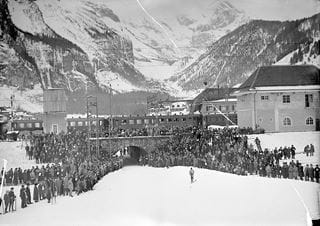
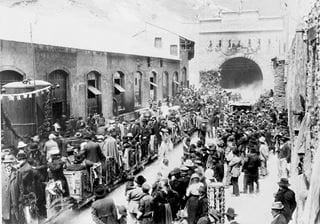
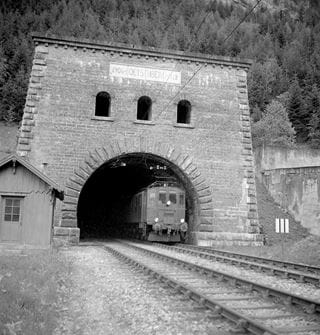
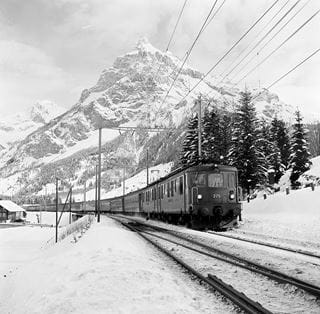
On 31 March 1911, the miners broke through the Lötschberg Tunnel. Just over two years later, the first train passed through this pioneering structure. More than 100 years later, the Lötschberg route is one of the key rail transit axes through the Alps. And BLS Ltd has evolved from an Alpine railway into an operator of suburban rail services.
After the opening of the Gotthard Railway in 1882, the Canton of Bern found itself cut off from the main north–south transport axis. To counter this, the canton made full use of its federalist rights to establish its own transit railway.
However, no financial support could be expected from the Swiss Confederation. The federal authorities strongly opposed a competing transit route. As a result, the Canton of Bern had to secure funding elsewhere – unexpectedly from its western neighbour.
After France lost Alsace-Lorraine and the border crossing at Basel to Germany in 1871, economic circles in Paris became interested in financially supporting an attractive international transit railway through Switzerland. The border town of Delle was intended to become the new gateway to Switzerland and Italy.
Former Bernese government councillor Wilhelm Teuscher (1834–1903) developed several route variants via Frutigen–Lötschberg for such a railway. However, the Lötschberg project faced competition from a Wildstrubel route. Two competing route proposals emerged, dividing the Bernese cantonal government into opposing camps.
In the end, the pro-Lötschberg initiative committee prevailed: on 27 July 1906, just a few months before construction work began, the Bern–Lötschberg–Simplon Railway Company (BLS) was founded.
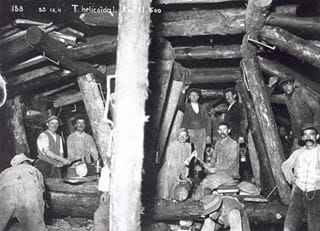
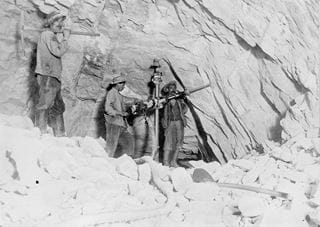
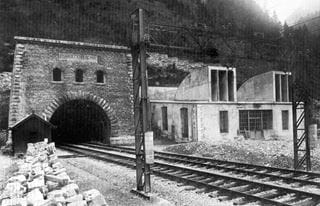
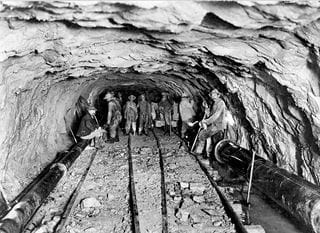
The overall construction work for the approximately 58-kilometre mountain railway line between Frutigen and Brig was awarded to a French construction consortium. Work on the 13.7-kilometre Lötschberg Tunnel began on 15 October 1906. In the same year, the Simplon Tunnel between Brig and Iselle in Italy was inaugurated.
As early as 1907, the federal authorities required BLS to expand the Lötschberg Tunnel to double track and to design the access ramps accordingly. However, due to financial constraints, a full-length substructure for a second track could not be realised. Only the Lötschberg Tunnel itself was built with double track.
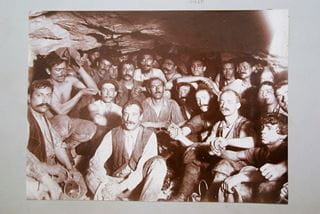
On 24 July 1908, during excavation works directly beneath the Gastern Valley, large amounts of water and sedimentary rock broke into the tunnel shaft. Twenty-five Italian miners lost their lives in the disaster. Following this tragic event, construction work was suspended for around six months. The tunnel section filled with debris was sealed off and a bypass around the accident site was planned.
As a result, three curves had to be built inside the mountain, making the Lötschberg Tunnel slightly longer than originally planned – 14.6 kilometres instead of 13.7 kilometres. On 31 March 1911, after four and a half years of construction, the breakthrough was achieved.
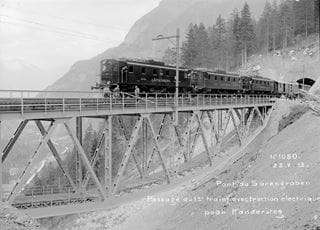
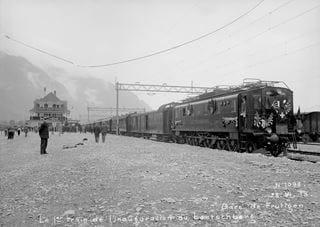
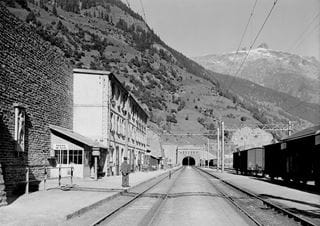
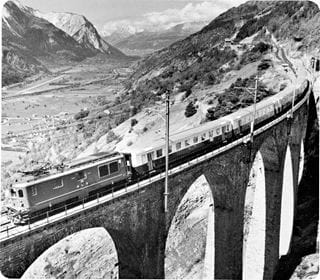
After the access ramps on both sides of the Lötschberg had been completed with their impressive engineering structures (33 tunnels, 22 bridges and 3 avalanche protection galleries), the electrified Lötschberg Railway (15,000 volts, 16 2/3 hertz alternating current) officially entered service on 19 June 1913.
For only a short time, international transit trains crossed the Alps via the Lötschberg route before the First World War and its consequences began to emerge on the horizon.
With the takeover of the Thun Lake Railway Thun/Scherzligen–Interlaken–Bönigen (TSB), BLS became in 1913 the operating company for the Bern–Neuchâtel Railway (BN – 43 km), the Gürbetal–Bern–Schwarzenburg Railway (GBS – 52 km) and the Spiez–Erlenbach Railway (SEZ – 35 km). Through the merger with TSB, the Lötschberg Railway also became operator of navigation services on Lake Thun and Lake Brienz.
In 1915, BLS opened the Grenchenberg line between Moutier and Lengnau, including the 8.5-kilometre Grenchenberg Tunnel. The route via Delle to Grenchen and Biel was intended to bring France closer to the Lötschberg route and thus to Italy. Until then, crossing the Jura Mountains between Moutier and Biel had only been possible via detours.
However, when Alsace-Lorraine was returned to France under the Treaty of Versailles in 1919, the border point of Delle lost its importance. Transit traffic once again shifted back to the Basel/St-Louis route.
Thanks to growing freight transport between Germany and Italy via the Lötschberg–Simplon route, BLS managed to compensate for the loss of transit traffic. Domestic Swiss traffic to the canton of Valais also experienced significant growth. No one any longer doubted the political and economic importance of the new Alpine crossing.
In 1976, the Federal Council approved a construction loan of 620 million Swiss francs for the gradual expansion of the Lötschberg line to double track. Construction work began one year later. On 8 May 1992, the fully double-track Lötschberg line was officially inaugurated.
At the end of 1993, the Swiss Confederation commissioned BLS to provide a rolling highway corridor for trucks on its route until the opening of the base tunnel. The corresponding construction work began in January 1994.
The opening of this transit corridor was delayed due to geological problems on the southern side of the Simplon route. Operations finally commenced on 11 June 2001.
Since then, the “Rolling Highway” – the transport of trucks by rail from Germany via the Lötschberg route to Italy – has made a significant contribution to shifting transit traffic from road to rail.
Towards the end of the 20th century, the economic, political and legal environment of European railways changed so significantly that restructuring within railway companies became unavoidable.
Liberalisation and competition also reached the railway sector. BLS Lötschbergbahn responded at an early stage and strategically repositioned itself: on 1 January 1997, the jointly operated railways BN, GBS and SEZ merged with BLS to form BLS Lötschbergbahn AG.
The organisational structure of BLS was also completely modernised. The new organisation was built around the three performance-oriented core businesses: infrastructure, passenger transport and cargo. This resulted in a financial and organisational separation between the infrastructure and transport divisions.
In order to remain competitive within the European rail market, BLS and SBB agreed on a new division of responsibilities, which they formalised in a framework agreement in May 2001.
Most of the agreement was implemented with the timetable change on 12 December 2004: BLS took over the S-Bahn lines previously operated by SBB and thereby assumed overall responsibility for the Bern S-Bahn – the second-largest suburban rail network in Switzerland. At the same time, BLS transferred its long-distance services to SBB.
In the cargo sector, SBB assumed system leadership for single wagonload traffic in Switzerland. Since then, competition has existed in transit and block train transport.
Today, SBB is responsible for nationwide network management. Following the opening of the Lötschberg Base Tunnel, BLS assumed operational management of the entire Lötschberg–Simplon axis.
On 27 September 1992, the Swiss population voted by a large majority in favour of the New Rail Link through the Alps (NEAT) project. With this vote, the people expressed their support for the construction of two Alpine transit routes – one through the Gotthard and the other through the Lötschberg.
The original Lötschberg project planned a 41-kilometre base tunnel with two tubes between Frutigen and the Rhône Valley. However, for financial reasons, the project was scaled down: the tunnel length was reduced to 34.6 kilometres. One of the two tubes was, for the time being, constructed largely only as a shell structure.
From 2007 onwards, trains were expected to travel through the Lötschberg Base Tunnel at speeds of 160 to 200 km/h. The Lötschberg NEAT project was built by the BLS subsidiary company BLS AlpTransit AG.
The opening of the base tunnel took place on 15 June 2007. Full commercial operation began with the timetable change on 9 December 2007.
In June 2006, Regionalverkehr Mittelland AG and BLS Lötschbergbahn AG merged to form BLS Ltd. The shareholders of both railway companies approved the merger at the general meetings held on 22 June 2006 (RM AG) and 23 June 2006 (BLS Lötschbergbahn AG).
The owners of the new company BLS Ltd are the Canton of Bern with 55.8%, the Swiss Confederation with 21.7%, and other cantons, municipalities and private shareholders with a combined share of 22.5%. The actual foundation of BLS Ltd took place on 24 April 2006 through the exchange of BLS and RM shares for shares in BLS Ltd by the participating cantons of Bern, Lucerne, Solothurn, Valais and Neuchâtel.
With this merger, BLS Ltd became, alongside SBB, the largest transport services company operating on Switzerland’s standard-gauge rail network. The company provides regional passenger transport across an area stretching from Lake Neuchâtel to Lake Lucerne and from the Jura Mountains to the Simplon massif.
Operations and services of the Bern S-Bahn can now be managed under one organisation. Every year, 37 million passengers use the regional and S-Bahn trains operated by BLS Ltd – and the number continues to grow.
1835
Beginning of scheduled steamship operations on Lake Thun, predecessor of today’s BLS navigation services
1864
Opening of the industrial horse-drawn railway between Derendingen and Biberist, predecessor of the Emmental Railway
1872 - 1874
Construction and commissioning of the Bödeli Railway (Därligen–Interlaken–Bönigen), predecessor of today’s line to Interlaken West
1875
Opening of the Emmental Railway (EB) Burgdorf–Solothurn
1881
Opening of the Burgdorf–Langnau line
1889
Opening of the Langenthal–Huttwil line (LHB)
1895
Opening of the Huttwil–Wolhusen line (HWB)
1899
Opening of the Burgdorf–Thun Railway (BTB), Europe’s first fully electric railway
1893
Opening of the Lake Thun Railway (TSB) Thun–Därligen
1897
Opening of the Spiez–Erlenbach Railway (SEB)
1901
- Opening of the Spiez–Frutigen Railway (SFB)
- Opening of the Bern–Neuchâtel Railway (BN)
1901/1902
Opening of the Gürbetal Railway (GTB)
1902
Opening of the Erlenbach–Zweisimmen Railway (EZB)
1906
Establishment of the Bernese Alpine Railway Company Bern–Lötschberg–Simplon (BLS)
1907
Opening of the Bern–Schwarzenburg Railway (BSB)
1908
- Opening of the Solothurn–Moutier line (SMB)
- Opening of the Ramsei–Sumiswald–Huttwil line (RSHB)
1913
- Opening of the electrified Lötschberg Railway Frutigen–Kandersteg–Brig
- Opening of the Lötschberg Tunnel
1915
- Opening of the Grenchenberg Tunnel (BLS line Moutier–Lengnau)
- Opening of the Huttwil–Eriswil line (HEB), converted to bus operation in 1975
1926
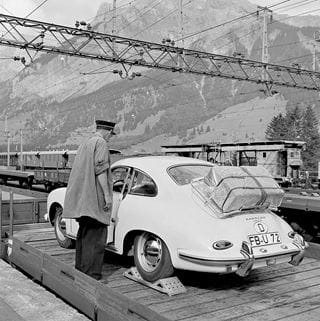
Transport of the first accompanied cars on open freight wagons between Kandersteg and Brig
1940
Opening of the loading terminals in Spiez, Frutigen, Hohtenn and Goppenstein
1942
- Merger of EB and BTB into the Emmental-Burgdorf-Thun Railway (EBT)
- Merger of SEB and EZB into the Simmental Railway (SEZ)
1944
- Merger of LHB, HWB, HEB and RSHB into the United Huttwil Railways (VHB)
- Merger of GTB and BSB into the Gürbetal-Bern-Schwarzenburg Railway (GBS)
1955
Free transport for vehicle drivers on car shuttle trains introduced on 1 April 1955
1959
Opening of the loading facilities in Iselle
1960
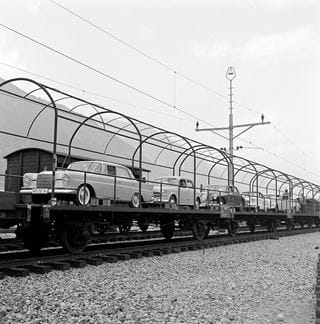
Start of scheduled car shuttle services
1966
For the first time, the BLS car shuttle transported more than 100,000 vehicles in one year
1968
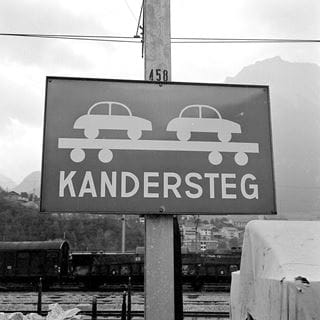
- Construction of a new vehicle ramp in Kandersteg
- Expansion of the loading tracks in Goppenstein
- Procurement of the first four-axle loading wagons
1970
On 8 September 1970, the BLS car shuttle reached the milestone of 1 million transported vehicles
1971
Closure of car shuttle services at Spiez, Frutigen and Hohtenn stations
1974
Introduction of the easy-to-remember 30-minute interval timetable for car shuttle services
1976
- Beginning of the double-track expansion of the transit route Thun–Brig
- Opening of the new loading facilities in Kandersteg and Goppenstein on 11 November 1976
1992
- Introduction of the new “Talbot” wagons for medium-sized trucks and buses on 1 June 1992
- Discontinuation of direct car trains between Kandersteg and Iselle in September
1993
Foundation of the subsidiary company BLS AlpTransit AG
1994 –2000
Expansion of the transit route into a 4-metre rolling highway corridor
1997
- Merger of the jointly operated companies BN, GBS and SEZ with BLS to form BLS Lötschbergbahn AG
- Merger of EBT, SMB and VHB into Regionalverkehr Mittelland AG (RM)
2000
Reintroduction of direct car trains between Kandersteg and Iselle (Easter, Ascension, Pentecost, Christmas and summer holidays)
2001
- BLS/SBB framework agreement (new division of long-distance transport: SBB; Bern standard-gauge S-Bahn: BLS)
- Foundation of the subsidiary company BLS Cargo AG
- Foundation of RAlpin AG and launch of the “Rolling Highway” Freiburg im Breisgau (D)–Lötschberg–Novara (I)
2003
The BLS car shuttle reaches 30 million vehicles transported through the Lötschberg
2006
- Foundation of BLS Ltd on 24 April 2006
- Merger with RM AG on 22 June 2006
- Merger with BLS Lötschbergbahn AG on 23 June 2006
2007
- Opening of the Lötschberg NEAT on 15 June 2007
- Start of full scheduled operations through the Lötschberg Base Tunnel on 9 December 2007
2009
Spin-off of BLS infrastructure into BLS Netz AG and its merger with BLS AlpTransit AG on 22 April 2009
2010
- Takeover of all rail traffic in the triangle between Lucerne, Langnau and Langenthal on 12 December 2010
- The BLS car shuttle transports its 40 millionth vehicle
2011
On 3 March 2011, the 100,000th train passes through the Lötschberg Base Tunnel after three years of operation
2012
- Groundbreaking ceremony for the Rosshäusern Tunnel and the Rosshäusern–Mauss double-track expansion on 20 April 2012
- On 19 September 2012, the new double-decker train enters scheduled service on the Bern S-Bahn for the first time
2013
- The first blasting for the excavation of the two-kilometre Rosshäusern Tunnel takes place on 6 May 2013
- Exactly 100 years after the opening of the 60-kilometre Lötschberg line, BLS operates a special train to Domodossola on 15 July 2013
2016
BLS takes over regional rail services between Brig and Domodossola. One year later, the Simplon car shuttle service is added
2017
BLS founds the subsidiary company BLS Immobilien AG to develop properties no longer needed for railway operations for new uses
2019
BLS resumes long-distance services and founds the subsidiary BLS Fernverkehr AG for this purpose. It takes over the InterRegio service between Bern and Biel. One year later, the InterRegio lines Bern–Olten and Bern–Neuchâtel–La Chaux-de-Fonds, which change from regional to long-distance services, are added.